Audit log search at 10k events per second: what we learned indexing Entra at scale.
Portal filters and one-off PowerShell exports break down when sign-in volume spikes. We built TenLens audit search for operators who need "who changed this policy in the last hour?" without downloading half a tenant to CSV first.
What 10k events per second means in Entra
Peak second rates are rare in a single tenant, but busy enterprises routinely ingest millions of sign-in and directory audit events per day. The operator experience is not defined by the average. It is defined by the hour where everything happens at once: password spray, CA rollout, break-glass activation.
At that scale, latency compounds. Export to Excel. Wait. Filter again. Miss the window.
Desktop, local creds, no middleman cache
We could have shipped a SaaS log lake. That would make benchmarks easy and subpoenas easier. TenLens is a desktop console: events land in a local index, encrypted with keys your OS manages, queryable without a round trip to our infrastructure.
- IngestAudit events stream in from Entra as they happen.
- StoreIndexed on your machine and encrypted with credentials only your device can unlock.
- QueryFull-text search in under 50 ms on a 30-day window for typical policy investigations.
How we index your audit stream
The pipeline is deliberately boring. Boring pipelines are operable at 3 a.m.
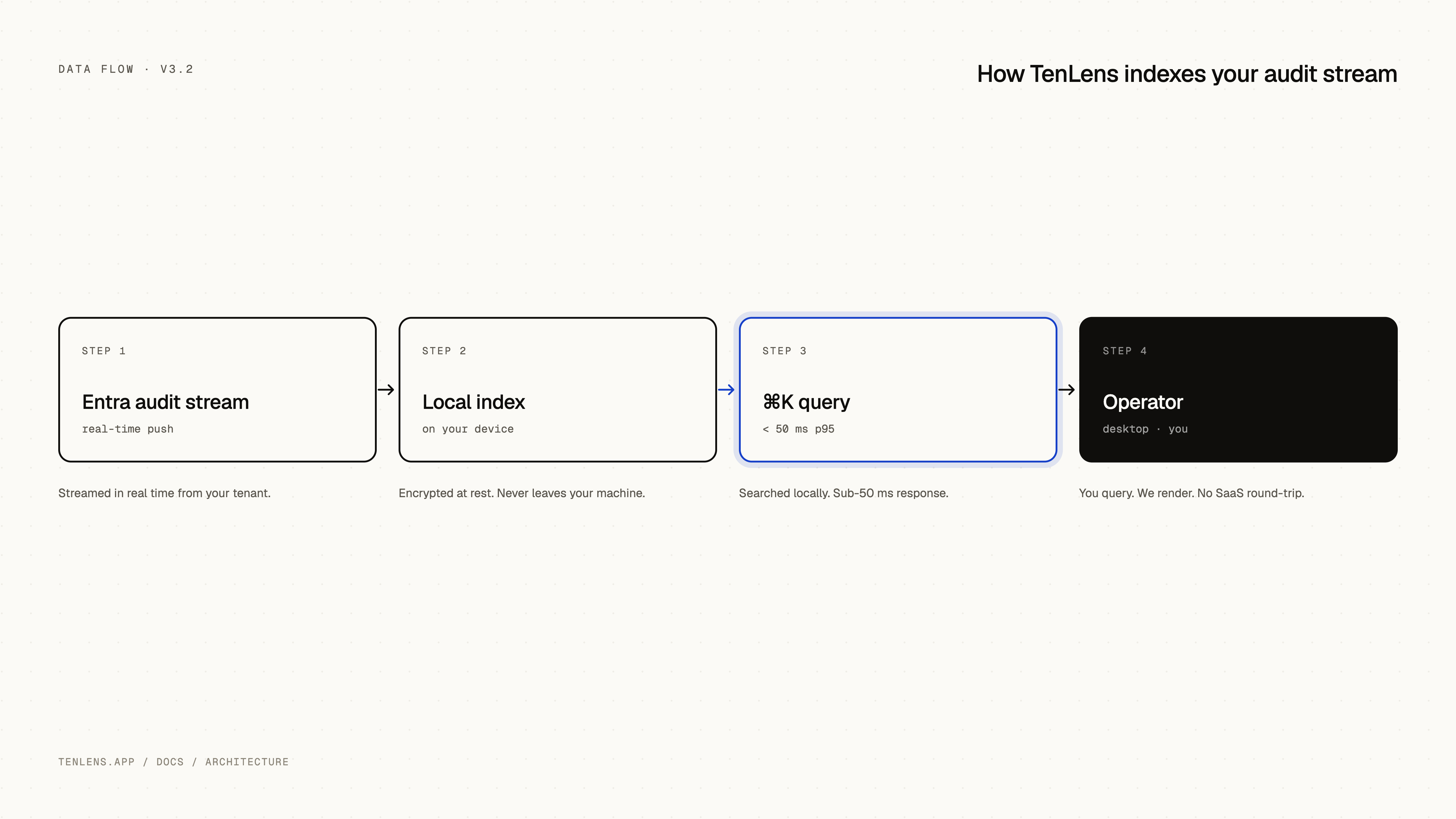
Events sync in real time. We normalize actor, target, and correlation once, then keep a searchable local index tuned for time ranges and policy investigations.
When you search for a policy change, you are not waiting on a remote service. The index already lives beside the console.
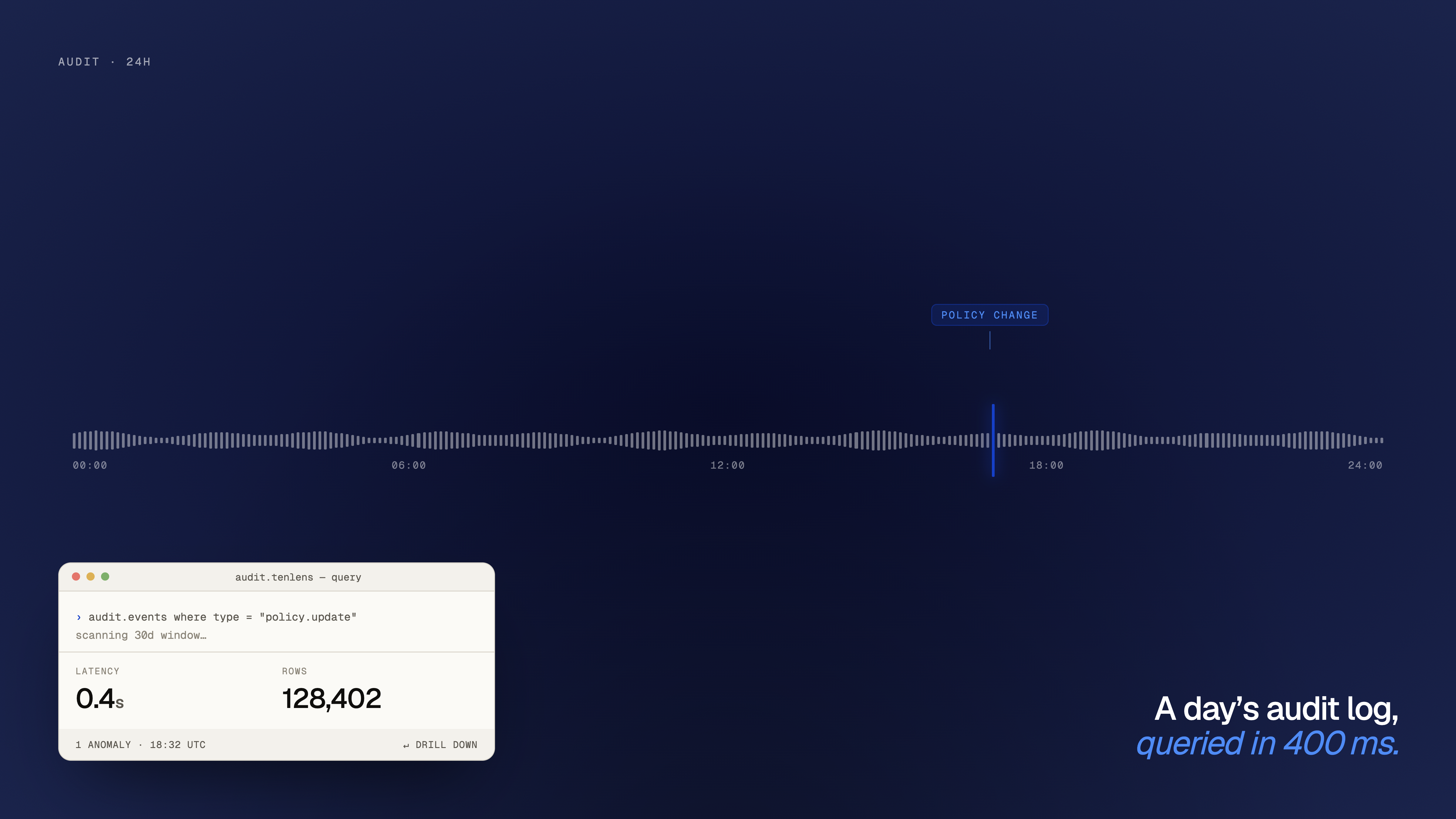
A day's audit log, queried in 400 ms. That is the bar we hold ourselves to on a laptop, not in a slide deck.
Live tail, pinned queries, export to SIEM
The audit view supports three modes operators asked for repeatedly:
- Live tail for incidents, with anomaly markers on the timeline.
- Pinned queries for recurring compliance checks (privileged role changes, CA updates).
- Immutable export to your SIEM format when the investigation leaves the laptop.
Drill-down keeps context: from a spike on the 24-hour waveform to the single policy change that caused it.
What we still cannot promise
Local indexing means retention is bounded by disk and policy, not an infinite cloud retention tier. Very long cold-archive search may still belong in your SIEM. We are honest about that trade.
We are benchmarking with a few design partners who run heavy hybrid sign-in volume. If that is you, reach out at support@tenlens.com.